

How to Upgrade Home Coffee Ritual: A Step-by-Step Guide
Table of Contents
- Step 1: Assess Your Current Home Coffee Setup
- Step 2: Find the Best Coffee Grinder for Home Brewing
- Step 3: Master Coffee Brewing Ratio and Grind Size
- Step 4: Learn How to Brew Specialty Coffee at Home
- Step 5: Troubleshoot Common Brewing Problems
- Step 6: Build Morning Coffee Ritual Ideas That Stick
- Step 7: Maintain Your Gear for a Better Home Coffee Ritual
- Frequently Asked Questions
Last Updated: October 17, 2026
Step 1: Assess Your Current Home Coffee Setup
Before you buy a single piece of gear for your home coffee ritual, take stock of what you already own. The honest answer to "what should I upgrade first?" depends entirely on where your setup is weakest today.
Here's how we'd audit a home coffee setup in five minutes:
- Grinder: Blade or burr? Pre-ground coffee sitting in a bag?
- Brewer: Drip machine, pour-over, French press, or espresso machine?
- Water: Tap, filtered, or bottled?
- Scale: Do you weigh your coffee, or scoop it?
- Beans: How long ago were they roasted?
Most people guess the machine is the problem. It usually isn't. The grinder and the beans matter more, and both are cheaper to fix.
Once you know your weak link, the rest of this guide becomes a sequence instead of a shopping spree.
Step 2: Find the Best Coffee Grinder for Home Brewing
The best coffee grinder for home brewing is a burr grinder, because it produces uniform particles that extract evenly. Blade grinders chop unevenly, which means fine dust and coarse chunks in the same dose. That inconsistency is why so many home cups taste bitter and sour at once.
Burr grinders come in two types:
- Conical burr: quieter, more forgiving, great for drip and French press
- Flat burr: faster, more precise, favored for espresso
Burr vs. Blade: What Actually Matters
What matters is consistency, not the burr shape. A blade grinder gives you no control over grind size, so you can't dial in a brew or repeat a good result. A burr grinder lets you adjust in small steps and get the same cup twice.
Three specs separate a grinder that helps from one that fights you:
- Adjustment mechanism. Stepped grinders click into fixed settings; stepless grinders move continuously. Stepped is easier to repeat; stepless gives finer control for espresso. For drip and French press, a grinder with at least 30 distinct steps covers the range you need.
- Burr size and material. Larger burrs cut faster and generate less heat. Steel burrs stay sharp longer than ceramic but are more brittle if a stray stone gets in. Most home brewers do well with burrs in the 40-64 mm range.
- Retention and static. Retention is the coffee left inside the grinder after a dose. Low-retention designs (often single-dose grinders) keep stale grounds from mixing into your next cup. A few drops of water on the beans, the "Ross droplet" trick, tames static in dry kitchens.
Match the Grinder to Your Brewer
A grinder that excels at espresso can be frustrating for French press, and vice versa. Use this as a starting filter:
- Drip and pour-over: a conical burr grinder with a wide step range handles medium grinds well and is forgiving of small errors.
- French press: you need coarse consistency more than micro-adjustment; almost any quality burr grinder works.
- Espresso: you need fine, repeatable steps and low retention. This is where flat burrs and stepless adjustment earn their keep.
If you drink espresso or milk-based drinks, grind consistency decides whether your shot pulls sweet or bitter. That's why we roast our espresso-focused coffees, like our Mamiami Colombian, to reward a properly dialed grind.

A grinder is the one upgrade that changes every cup you make, regardless of brewer. Get it right and the rest of your setup has a chance to perform.
Step 3: Master Coffee Brewing Ratio and Grind Size
Coffee brewing ratio and grind size are the two variables that control extraction. Get them right and everything else gets easier.
Start with a 1:16 ratio by weight: one part coffee to sixteen parts water. For a standard mug, that's roughly 18 grams of coffee to 290 grams of water.
Grind size should match your brewer:
- French press: coarse, like sea salt
- Pour-over: medium, like table salt
- Espresso: fine, like powdered sugar
Weigh your beans. Scoops vary wildly, and a scale is the cheapest precision upgrade you can make.
Step 4: Learn How to Brew Specialty Coffee at Home
To brew specialty coffee at home, control four things: fresh whole beans, a consistent grind, water just off the boil, and steady timing. Nail those and you'll out-brew most cafés.
Here's a simple pour-over method:
- Rinse the filter and warm the cup.
- Add 18 g of medium-ground coffee.
- Pour 40 g of water, wait 30 seconds.
- Pour the remaining water in slow circles.
- Finish between 2:30 and 3:30 total.
Freshness is the variable people skip. Whole beans hold their flavor far longer than pre-ground, and small-batch roasting keeps that window open. Our single-origin coffees from Colombia, Guatemala, and Bali are roasted in small batches and shipped within 2-4 business days, so the bag arrives close to its roast date.
The Sexy Barista Discovery Set →
Step 5: Troubleshoot Common Brewing Problems
Most bad cups trace to one of four causes. Here's the fix for each:
| Problem | Likely Cause | Fix |
|---|---|---|
| Bitter, harsh taste | Over-extraction | Coarser grind, shorter brew |
| Sour, thin taste | Under-extraction | Finer grind, hotter water |
| Weak, watery cup | Too little coffee | Raise the dose on your scale |
| Muddy, silty cup | Too fine a grind | Coarsen and slow the pour |
Change one variable at a time. If you adjust grind and dose together, you won't know which fix worked.
A common mistake is blaming the beans for a bitter shot when the grind is simply too fine. Dial in the grind first, then judge the coffee.
A Diagnostic Sequence That Actually Works
Competitors stop at the table. The harder skill is knowing what to change first. Work through this order every time a cup disappoints:
- Taste before you touch anything. Decide whether the cup is bitter (over-extracted), sour (under-extracted), weak (under-dosed), or muddy (too fine). Write it down. Memory lies between cups.
- Check dose and ratio first. Weigh your coffee and water. If the dose drifted, fix that before touching the grinder. A 2-gram dose error changes extraction more than one click on most grinders.
- Adjust grind by one step. Finer for sour, coarser for bitter. Brew again. If the cup moves in the right direction but isn't there yet, take another step.
- Adjust water temperature last. Water just off the boil (about 200-205°F) suits most brewers. If your kettle has no thermometer, a cheap instant-read probe is the most useful diagnostic tool in the kitchen.
- Change beans only after the above. If three grind adjustments and a confirmed dose still produce a bad cup, the beans are the variable.
Reading the Signs Beyond Taste
Taste isn't the only signal. Watch the brew itself:
- Pour-over drains too fast (under 2:00): grind is too coarse or dose too low. Slow it down with a finer grind before adding more coffee.
- Pour-over stalls (over 4:00): grind is too fine or the bed is clogged with fines. Coarsen and pour more gently.
- French press plunger feels spongy: too many fines; coarsen the grind.
- Espresso shot runs in under 20 seconds: grind finer or increase dose. Over 35 seconds: coarsen or decrease dose.
Troubleshooting is a skill, not a purchase. The more cups you taste with attention, the faster you'll recognize which lever to pull, and the less equipment you'll buy trying to solve a problem that a single grind adjustment would have fixed.
Step 6: Build Morning Coffee Ritual Ideas That Stick
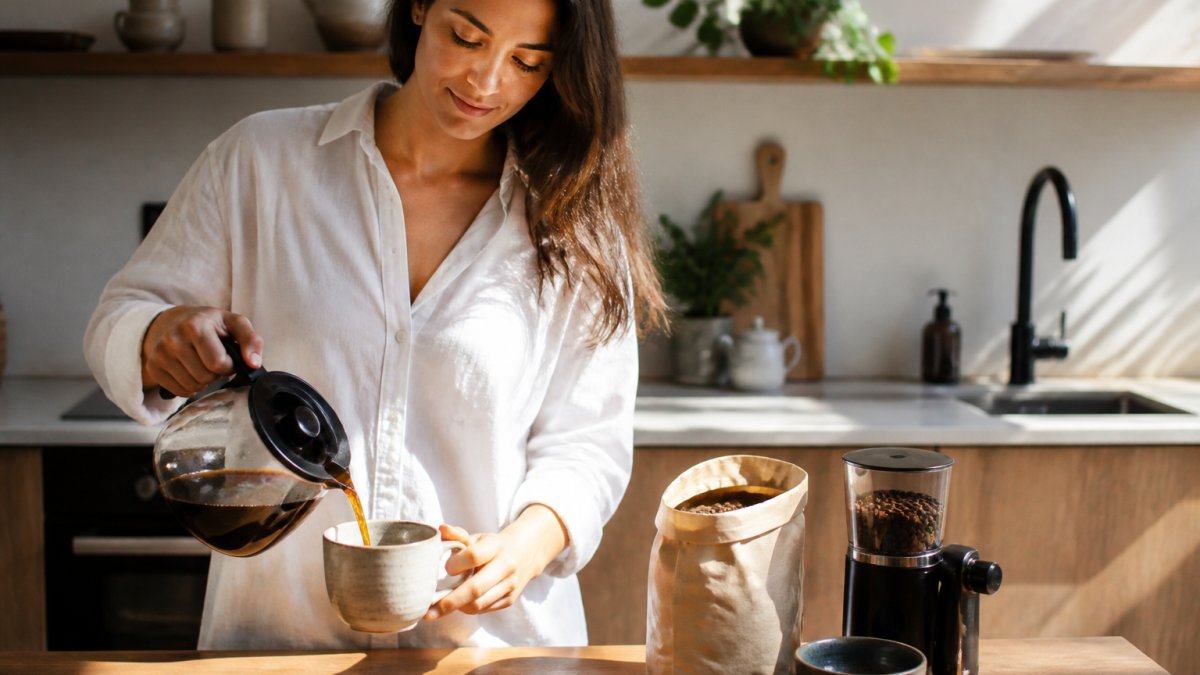
Morning coffee ritual ideas work best when they're small and repeatable. The goal isn't a longer routine, it's a more intentional one.
Try these:
- Weigh and grind while the water heats. Two minutes, fully hands-off.
- Use one good cup. A proper vessel makes the drink feel finished. Our 5.5 oz artisan cup is sized for espresso and cortados.
- Skip your phone for the first sip. Taste before you scroll.
- Rotate origins weekly. Different beans keep the ritual interesting.
The ritual is the point, not just the caffeine. A deliberate five minutes beats a rushed ten.

Step 7: Maintain Your Gear for a Better Home Coffee Ritual
Clean gear brews better coffee. Oils and residue build up fast, and stale oils turn rancid, which flattens flavor.
A simple upkeep schedule:
- Daily: rinse the brewer and cup
- Weekly: wash the grinder hopper and carafe with mild soap
- Monthly: run a descaling solution through any machine
- As needed: brush out the grinder burrs
Store whole beans in an airtight container, away from light and heat. Don't refrigerate them; moisture hurts more than it helps.
Keeping your equipment in good shape extends its lifespan and keeps every cup consistent. That's the quiet upgrade nobody talks about.
Frequently Asked Questions
What should I upgrade first in my home coffee setup?
Start with your grinder. A burr grinder gives you consistent grind size, which is the foundation for even extraction and better flavor. If you already have a decent grinder, upgrade your coffee beans next. Freshly roasted whole beans from a small-batch roaster make a bigger difference than a new machine. The Sexy Barista Discovery Set lets you try three single-origin coffees plus an artisan cup, so you can taste how origin changes your brew before committing to a full bag.
How do I know which grind size to use for my brewing method?
Grind size should match your brew time and method. For French press, use a coarse grind similar to sea salt. For pour-over, go medium-fine, like table salt. For espresso, use a fine grind that feels like powdered sugar. If your coffee tastes bitter, grind coarser. If it tastes sour or weak, grind finer. Adjust in small steps and keep your coffee-to-water ratio steady so you can isolate what changed.
How should I store specialty coffee beans at home?
Keep whole beans in an airtight container away from light, heat, and moisture. A opaque canister stored in a cool cupboard works well. Avoid the refrigerator because condensation and food odors can affect flavor. Buy amounts you will finish within two to four weeks of the roast date. Grind right before brewing to preserve aroma and carbon dioxide, which helps your coffee bloom and extract evenly during the brew.
What is a simple morning coffee ritual I can actually stick to?
Keep it short and repeatable. Set out your grinder and brewer the night before. In the morning, weigh your beans, grind them fresh, heat your water, and pour with attention. Use a cup you enjoy drinking from, like a 5.5 oz artisan cup for espresso or cortado. The ritual works because it is consistent, not complicated. A two-minute routine you repeat daily beats an elaborate weekend setup you abandon by Wednesday.
Your morning coffee deserves more than a rushed scoop and a stale bag. At Sexy Barista, we roast small-batch single-origin coffees in Miami and ship them fresh, so your home coffee ritual starts with better beans. Explore our Discovery Set to taste all three origins, or start a flexible subscription with free shipping on orders over $60. Get started with Sexy Barista and make your mornings bolder.


Leave a comment
This site is protected by hCaptcha and the hCaptcha Privacy Policy and Terms of Service apply.